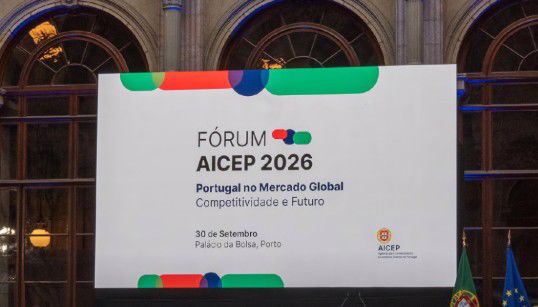
“Portugal in the Global Market: Competitiveness and the Future” was the theme of the AICEP Forum 2026, held on 20 September at the Palácio da Bolsa in Porto. The event focused on the challenges facing international trade, the current geopolitical context and Portugal’s positioning in global markets, both as a trading nation and as an investment destination. Portugal’s Minister of Economy and Territorial Cohesion, Manuel Castro Almeida, stressed the need for Portuguese companies to find in international markets “the scale that the country’s territory alone cannot offer”. The Forum also marked a change in AICEP’s leadership, with Madalena Oliveira e Silva stepping down and Ana Casaca taking over as president of the Agency on 1 October.
At the opening of the Forum, Madalena Oliveira e Silva, who was due to leave her post as AICEP president just hours later, began by addressing the business community, to which she dedicated a special message. “Companies are what turn talent into value, knowledge into innovation and ambition into an international presence”, she said. “Internationalisation is no longer an option. It is an imperative. It is an opportunity for growth. It enables companies to achieve scale, diversify markets, reduce dependencies and integrate into global value chains”.
Noting that the current environment is characterised by growing competition, geopolitical instability, rapid technological change and an accelerating energy transition, Madalena Oliveira e Silva stressed that these factors are reshaping value chains, investment patterns, business models and logistics routes. However, she also emphasised that this is a time of opportunity.
“Portugal has what it takes to continue establishing itself as a leading investment destination – stable, safe and a credible partner in international markets. Portuguese companies compete with the best in the world and demonstrate every day their ability to adapt, innovate and succeed in the most demanding markets”, Madalena Oliveira e Silva concluded, describing the occasion as a particularly special moment.
“I am concluding my term as AICEP president after more than 30 years in public service, dedicated to the institution and, above all, to businesses and my country,” she said. “I do so with pride in what we have achieved, gratitude for everything this journey has given me, and the conviction that the Agency is better prepared to meet the challenges of the future”.
Madalena Oliveira e Silva also highlighted the strengthening of AICEP’s international presence: its External Network now covers 50 markets, the Agency has supported more than 5,000 enquiries and generated over 1,700 business opportunities for Portuguese companies. She also noted that AICEP had significantly expanded its support for companies seeking to internationalise. During the first half of 2026, its initiatives reached approximately 7,000 companies, a 400 per cent increase on the same period in 2025.
“Looking at the country’s export profile – and this is particularly important – we can see the technological leap we have made in recent years. Between 2021 and 2025, exports of high-tech products almost doubled. Exports of knowledge-intensive services have more than doubled since 2020”, Madalena Oliveira e Silva said. She also pointed out that, under Portugal 2030, AICEP had approved almost 600 applications for internationalisation projects and had already processed more than 31.8 million euros in incentives.
In 2025, Portugal also reached a historic high in contracted investment, with AICEP signing agreements covering more than 3.58 billion euros in investment, backed by 803 million euros in incentives and expected to create approximately 6,600 jobs. “We have created value through more investment, more exports, more innovation and greater territorial cohesion”.
Concluding her address, Madalena Oliveira e Silva returned to her starting point: businesses. “AICEP exists to serve companies, and they are the true driving force behind Portugal”, she said, before wishing her successor, Ana Casaca, every success. Casaca took over as AICEP president on 1 October. “I am certain she will find teams of outstanding quality at AICEP, deeply committed to the country’s economic development and to the mission of serving businesses. AICEP’s success will always be the success of companies and, consequently, the success of Portugal”.
Ana Casaca takes on “a mission to serve the country”
Ana Casaca took to the AICEP Forum stage towards the end of the morning. She thanked Madalena Oliveira e Silva for the way she had led the Agency, noting that “strong institutions are built on memory and high standards”, and described the position she was about to take up as “a mission that is, first and foremost, about serving the country”.
Ambition, scale and impact were the three words Ana Casaca chose to emphasise in her address. “I am taking over AICEP with the aim of turning ambition into scale, and scale into impact, in order to strengthen Portugal’s position in the world”, she said. “We have highly competitive industrial companies, startups and technology businesses that are global from day one. We have talent and a unique geostrategic position, as well as a partnership with the world built over centuries”. She concluded with an optimistic message for Portuguese business leaders: “We can have more Portugal in the world and more of the world creating value in Portugal”.
With more than 20 years of experience in leadership, innovation and internationalisation, Ana Casaca holds a degree in Microbiology from the Portuguese Catholic University and an MBA from Porto Business School. Her career has focused on the intersection of business, science, technology, investment and public policy. She is a member of the European Innovation Council (EIC) Board, an advisory body to the European Commission on growth strategies for European technology companies. Until her appointment, she was Galp’s Director of Innovation.
Castro Almeida stresses the importance of achieving scale in the Portuguese economy
Scale was also a recurring theme in the address by Manuel Castro Almeida, Minister of Economy and Territorial Cohesion, as he closed the morning session of the AICEP Forum. “An economy such as Portugal’s cannot operate in isolation. We have to find in the world the scale that our territory alone cannot provide”, he argued. “Countries compete for talent and investment. The question is how we can become more relevant in a world where economic relevance has to be earned every day. We need an economy in which companies generate more value and knowledge is integrated into what we produce and sell”.
Highlighting AICEP’s role and the contribution of growing exports to the Portuguese economy, Castro Almeida stressed that businesses need predictability and must work in partnership with the State. He also underlined that knowledge is what distinguishes an advanced economy.
“In a changing world, Portugal must make better use of its position. We are deeply European, but our reach extends beyond the continent. The Atlantic, our ties with Africa, Brazil and Latin America, Portuguese communities around the world and our language give us a network that should be seen not merely as a historical legacy, but also as an economic asset”, Castro Almeida said. “Our task is to turn stability into investment, knowledge into value and an international presence into prosperity at home”.
Immediately after the Forum’s opening addresses by Porto Mayor Pedro Duarte and Nuno Botelho, president of the Porto Commercial Association – Chamber of Commerce and Industry, Secretary of State for the Economy João Rui Ferreira had also highlighted the importance of achieving greater scale in Portuguese business and the economy. “Our economy is more open, and our presence in activities with higher technological intensity is growing. But how can we achieve scale?” he asked. “Portugal’s technological capabilities are increasing. The challenge is to turn that capacity into competitiveness”.
Paulo Portas highlights international trade growth despite geopolitical risks
Geopolitics, geoeconomics and the reshaping of international trade were the focus of a presentation by Paulo Portas, former Deputy Prime Minister and vice-president of the Portuguese Chamber of Commerce and Industry, who addressed the AICEP Forum via a recorded video message. While acknowledging the various geopolitical risks having a significant impact on the global economy, Portas noted that international trade continues to grow, that new trade agreements are sending positive signals to the global economy and that Portugal is now “a calm and stable macroeconomic reference point”.
“Business leaders know, particularly since COVID, and even more so since Russia’s invasion of Ukraine and the outbreak of a new conflict in the Gulf involving the United States, Israel and Iran, that geopolitics comes knocking at their door, and not always in the most favourable way”, Portas said. Nevertheless, he argued that the current situation does not mean the end of globalisation.
“When people say, sometimes all too readily, that globalisation is over, we need to look carefully at the figures. International trade continues to grow. It could grow faster if barriers were lower, but it is still growing. And the reason is very simple: when we stop selling or stop buying, we become poorer”, Paulo Portas stressed.
Recent trade agreements are signs of the reshaping and expansion of international trade. Portas highlighted three examples: the African Continental Free Trade Area, the trade agreement between the European Union and India, and the EU–Mercosur agreement. “India is an emerging power in the global economy. It has become the world’s most populous country, overtaking China, whose growth is no longer in double digits and which is even struggling to grow by more than 5 per cent”, Paulo Portas noted.
Regarding the EU–Mercosur agreement, he stressed that Brazil alone represents a market of 215 million people. “The agreement is decidedly beneficial in areas that matter to us, such as the automotive sector, but it is also particularly advantageous for agri-food products, especially Portuguese olive oil and wine”.
Portas also welcomed the closer relationship between the European Union and Canada. “This rapprochement is a step in the right direction. Clearly, we will have to see what it means in practice, but if we look at the trade agreement between the European Union and Canada, it is one of the best the EU has concluded”.
Referring to World Trade Organization (WTO) projections that the current trend towards higher tariffs and sanctions could reduce global trade by around 5% by 2050, Portas posed a question: “Are we heading towards an era of more systemic protectionism, or is this trend — which has intensified considerably under the current US administration – likely to moderate”?
In his message to the AICEP Forum, the former Deputy Prime Minister also recalled visiting AICEP and its offices around the world, adding a clear appeal: “Keep going. Portugal needs an efficient AICEP”. He also urged Portuguese business leaders to invest in innovation and argued that Portugal should remain a welcoming country, with regulated immigration, “because we need human resources.”
Portugal in global markets and opportunities in new markets
Portugal’s position in global markets was the subject of a morning panel featuring AICEP delegates Rui Boavista Marques (Germany), Luís Sequeira (Canada) and Carlos Moura (New York, United States), who discussed the respective markets.
“I am convinced that Germany is an essential market for most Portuguese companies,” Rui Boavista Marques began. He noted that Germany is the world’s third-largest economy and Europe’s largest economy. “We have companies achieving extraordinary growth in Germany. Portugal has a trade surplus with Germany and, in technological sectors, it is often our leading market”, he concluded.
Regarding Canada, Luís Sequeira highlighted the country’s current proactive approach to finding new markets and suppliers. “The CETA agreement provides market access, and there is already a very tangible infrastructure in place. The key is to understand where further opportunities can be created”.
As for the United States, Carlos Moura recalled that it is one of Portugal’s most important markets: the fourth-largest destination for Portuguese goods exports and the leading market for investment. “It is effectively a collection of markets: 50 states with different regulations, each requiring a distinct analysis.” It is a complex market, he warned, “but one full of opportunities to achieve scale”.
Angola, South Korea and Saudi Arabia were also highlighted at the AICEP Forum during the afternoon panel entitled New Markets, New Opportunities. AICEP delegates Joana Barros (Angola), Guilherme Lopes (Saudi Arabia) and Hélio Campos (South Korea) presented their respective markets.
“More than 3,500 Portuguese companies export to Angola,” Joana Barros stressed. With a very young population and major companies driving its economy, Angola offers opportunities in areas such as agribusiness, the blue economy, technology, infrastructure and healthcare, the AICEP delegate explained.
Guilherme Lopes presented the Saudi Arabian market, noting that the country’s economy is diversifying and creating opportunities, particularly in the defence sector, among others. “For a Portuguese company, the best way to enter the market is to understand it, establish partnerships, cooperate and consolidate its position.”
South Korea was also presented as a market full of opportunities. “It ranks 15th worldwide and fourth among Asian economies”, Hélio Campos noted, highlighting the importance of leading South Korean companies such as Hyundai, Samsung and LG.
Combining tradition with innovation and attracting investment
The AICEP Forum also showcased several success stories in internationalisation and investment. A panel dedicated to internationalisation explored the combination of tradition and innovation, featuring examples from food company Casa Mendes Gonçalves, textile manufacturer LMA and technical footwear producer Aloft (see articles on these companies on the following pages).
Carlos Gonçalves, president of Casa Mendes Gonçalves, argued that Portuguese companies should not compete on price, “because that battle is already lost before it begins”. Instead, they should compete on the basis of higher added value. Alexandra Araújo, CEO of LMA – Leandro Manuel Araújo, highlighted the importance of Made in Portugal, noting that “our culture has changed in recent years, and we now prefer Portuguese products”.
Focusing on innovation, Pedro Castro, CEO of Aloft, shared his company’s experience and highlighted the role academia can play in business development. “Our academic institutions respond very well, at an astonishing speed. They have an enormous amount of knowledge and are willing to come and work on the factory floor.”
Shortly afterwards, representatives from Synopsys, Tridonic and Critical Software took to the AICEP Forum stage (see articles on the following pages) to discuss investment and engineering without borders. Célio Albuquerque, vice-president of Synopsys, explained that in the semiconductor sector, in which the company operates, technology is evolving towards the use of less scarce metals and more sustainable production methods. Artificial intelligence is also creating new opportunities, he added.
“Technology creates a range of opportunities that apply across the world, and we need to strengthen our commitment to this area”, reiterated João Granjo Lopes, managing director of Tridonic.
Luís Cargaté, Chief Revenue Officer at Critical Software, delivered a similar message to Portuguese companies: “We are operating in an extremely competitive economy, but the opportunities are there. This is certainly not a time when there is no market demand. Opportunities exist, and technology allows us to do things we could not have dreamed of just a few months ago.”
Following a morning devoted to strategic vision, internationalisation and investment, the afternoon sessions of the AICEP Forum 2026 also addressed Promoting Portugal with Purpose, Brand Portugal and International Companies in Portugal (see boxes), as well as the EU–Mercosur agreement and the opportunities it offers Portuguese companies (see the interview with Chris Ruff of DG Trade in this issue).
Brand Portugal: being known is no longer enough – you have to be chosen
The importance of Brand Portugal was a key theme at the AICEP Forum 2026. A session featuring Francisco Teixeira, Country Manager of WPP Group in Portugal, and Fernando Daniel Nunes, CEO of Vista Alegre, reaffirmed Brand Portugal as a strategic asset for generating value, strengthening the country’s competitiveness and supporting internationalisation in global markets.
Portugal has increased its international appeal over the past five years but still faces the challenge of turning awareness into business opportunities, Francisco Teixeira stressed. During the session, he presented findings from the BrandAsset Valuator (BAV) study, which analyses brands from a cultural and behavioural perspective.
Starting from the premise that countries should be understood as brands, the WPP executive highlighted Portugal’s 22nd-place ranking among the countries most favoured by global decision-makers. Portugal is recognised for attributes such as adventure, heritage, cultural influence, agility and citizenship. However, he also identified areas with room for improvement, including quality of life, entrepreneurship, openness to business and the ability to strengthen the country’s international profile.
According to Francisco Teixeira, Portuguese products should serve as a gateway to the country and its value proposition. “Being known is not enough; being chosen is everything”, he said, advocating a strategy based on highlighting Portugal’s distinctive attributes, promoting Made in Portugal as tangible proof of quality, and shifting from image-focused communications towards an approach centred on converting awareness into business.
Fernando Daniel Nunes, CEO of Vista Alegre, explained that the company has been consolidating its international position through a strategy combining tradition, innovation and the value of its Portuguese origins. Vista Alegre, he noted, went through a period of difficulty but successfully repositioned itself by combining tradition and modernity and strengthening its links with art, design and culture.
The creation of collections with international designers, gradual expansion into lifestyle categories and a focus on high-end hospitality were among the strategic decisions underpinning this transformation.
For Vista Alegre’s CEO, it was also important to prioritise quality over quantity in distribution channels, ensuring the brand was present in the markets and retail outlets best suited to its positioning.
Multinationals highlight opportunities for Portuguese suppliers in global value chains
Opportunities for new suppliers to join the value chains of multinational companies operating in Portugal were discussed at the AICEP Forum 2026 during the session International Companies in Portugal: Partnerships for Growth. The panel featured Rui Almeida, Global Procurement Director at Hovione, and Vitor Gorni, Purchasing Manager at WEG, and was moderated by Pedro Pinto de Sousa of AICEP.
At Hovione, Rui Almeida explained that the choice between local and global suppliers depends on the procurement category in question. However, he emphasised the company’s strong commitment to developing partnerships in Portugal. According to the Hovione executive, the company has acted as a gateway to the pharmaceutical industry for several Portuguese businesses, enabling them to acquire knowledge and experience that subsequently help them expand into other markets and geographical areas.
Vitor Gorni described Portugal as a strategic location for WEG’s European operations. The company established its first facility outside Latin America in Portugal. It is now the group’s largest industrial manufacturing site in Europe and the only facility to bring together all five of the multinational’s business areas.
He also stressed the importance of a solid and diversified supplier base in supporting the company’s growth. “Competitiveness is an essential requirement, but responsiveness and meeting deadlines are playing an increasingly important role in purchasing decisions,” Vitor Gorni said. He argued that the combination of agility and competitiveness creates opportunities for Portuguese suppliers to establish themselves as partners to major international groups.
Promoting Portugal with purpose: “A safe and stable country”
Portugal is a safe and stable country, recognised for its know-how, Paulo Rios de Oliveira, AICEP’s executive director, recalled during the Forum session entitled Promoting Portugal with Purpose: Aligning Priorities to Strengthen International Awareness.
“The playing field has changed, but the game goes on”, the AICEP executive said, stressing that globalisation has not ended; “it is changing its geography”. Although Portugal is a peripheral country in Europe, it enjoys a privileged position on the Atlantic.
Paulo Rios de Oliveira focused on Portugal’s role in the world and the European Union, as well as on AICEP’s contribution. “The world has always been changing, but now it is changing in a highly disruptive way” he said. “Everything has changed, and so have the rules governing international trade.”
Turning to AICEP’s work, Paulo Rios de Oliveira highlighted the Agency’s role in attracting investment and supporting internationalisation. “AICEP takes companies out into the world and brings the world to Portugal.”