
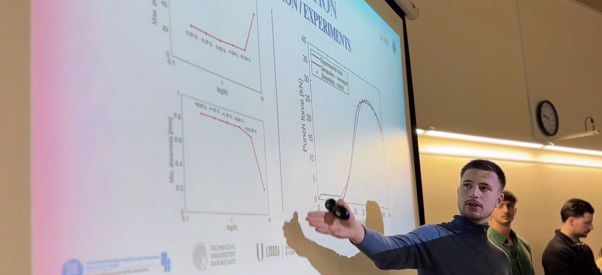
The initiative brought together students and academics from the University of Lisbon, the Technical University of Darmstadt (Germany), and the Universitat Politècnica de Catalunya – BarcelonaTech (Spain), providing an international learning experience centred on solving a real-world engineering challenge.
Delivered between September 2025 and January 2026 as a 6 ECTS course unit, the project promoted collaboration among multicultural and multidisciplinary teams while giving students hands-on experience in addressing an industrial engineering problem.
Engineering for a more sustainable industry
The project focused on reducing the environmental impact of sheet metal stamping processes, which are widely used in sectors such as the automotive and home appliance industries. During stamping, friction between the metal sheet and the forming tool is significant, making chemical lubricants essential to prevent material damage and surface defects.
The project explored a more sustainable alternative by creating microscopic surface textures on the metal. These tiny features, invisible to the naked eye, act as natural lubricant reservoirs, helping to reduce friction while lowering the amount of lubricant required during the manufacturing process.
To evaluate this approach, the team investigated two different surface texturing techniques, combining computer simulations with experimental testing.
Read more here.