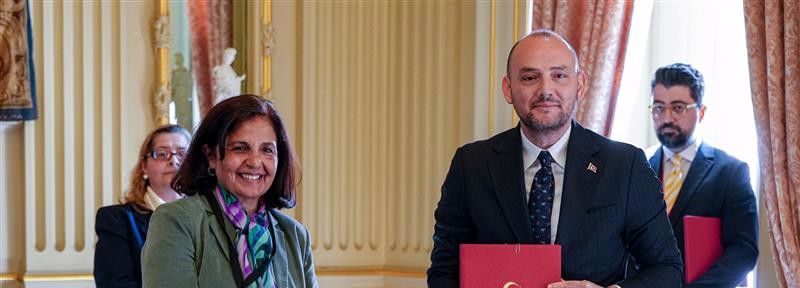
Portugal and Türkiye have strengthened their economic ties with the signing of a memorandum of understanding between AICEP, the Portuguese Agency for Investment and Foreign Trade, and the Foreign Economic Relations Board of Türkiye (DEİK), within the framework of the 5th meeting of the Portugal–Türkiye Joint Economic and Trade Commission (JETCO), held in Lisbon. The agreement aims to enhance institutional cooperation, promote investment, and intensify trade relations, creating a framework of collaboration that supports Portuguese companies in Türkiye and Turkish companies in Portugal.
At the opening session, Minister of Foreign Affairs Paulo Rangel highlighted the growing importance of the bilateral forum, stating that it has become “indispensable for economic and diplomatic dialogue between Portugal and Türkiye”. Noting that 2026 marks a century of diplomatic relations between the two countries, he called for renewed ambition in the bilateral relationship.
The Minister of Foreign Affairs advocated a strengthened geostrategic vision for the bilateral relationship, proposing that it be seen as an alliance based on the complementarity of the two countries. He stated that Portugal and Türkiye should be regarded as strategic gateways to Europe, with Portugal connected to the Euro-Atlantic space and the Lusophone world, and Türkiye serving as a bridge to the Caucasus, the Middle East, and Central Asia.
Türkiye’s Minister of Trade, Ömer Bolat, reinforced this idea, noting that “both countries occupy strategic positions in relation to the European continent”, and highlighted the interest of Turkish companies in participating in Portuguese projects, stating that the country is “ready to make its best contribution to Portuguese projects, in partnership with Portuguese companies”.
The President of AICEP, Madalena Oliveira e Silva, underlined the agency’s role in supporting businesses, highlighting its presence in Ankara as a tool for facilitating economic relations. “We believe there is significant potential for Portugal and Türkiye to develop their trade relations.” She emphasised the recent growth in trade, particularly in the automotive, machinery, and industrial goods sectors. “This positive progress shows there is scope to deepen our relationship,” she stated, identifying three priority areas for cooperation: industrial partnerships, joint development in technologies and renewable energy, particularly solar, and collaboration in infrastructure.
Secretary of State for the Economy, João Rui Ferreira, highlighted the positive evolution of economic relations but warned that they still fall short of their potential. “I feel we are satisfied with the results we have achieved, but we are far from our true potential,” he said, advocating a stronger business presence in international markets. “We cannot do business sitting in our offices, in our own countries. We must understand the market, be present, and establish partnerships.” He also stressed Portugal’s strategic positioning, particularly in renewable energy, including solar, wind, and green hydrogen, as well as AICEP’s role as a facilitator of foreign investment, stating: “AICEP is the door to knock on.”
The Secretary of State for Infrastructure, Hugo Espírito Santo, highlighted the aim of establishing Portugal as a European hub for data centres, as part of a wide-ranging programme of infrastructure investment that includes the transport, housing and mobility sectors.